 Skip to main content

Glazed units
Insulated glazing
All of our products are produced from high quality materials. The final products fully meet modern requirements, something which has been confirmed by the various certificates which have been granted for these products.
Our range includes only well-known European manufacturers, including Guardian, Euroglass, Saint Gobain, and Pilkington.
Insulated glazing can be made of two or three panes of glass which are hermetically connected to each other using a spacer frame. Free space is filled with an inert gas in the form of argon. This space is referred to as a chamber.
The most commonly-used thicknesses of glazing are 24mm, 44mm, and 52mm.
Designations:
2к4-16-4LowE+arg refers to two panes of glass: 4mm comes with a frame of 16mm, with a 4mm energy saving, and with the gap between panes which is filled with argon.
3k4LowE-16-4-16-4LowE+arg refers to three panes of glass: 4mm energy saving comes with a frame of 16mm, with a 4mm energy saving, and with the gap between panes which is filled with argon.
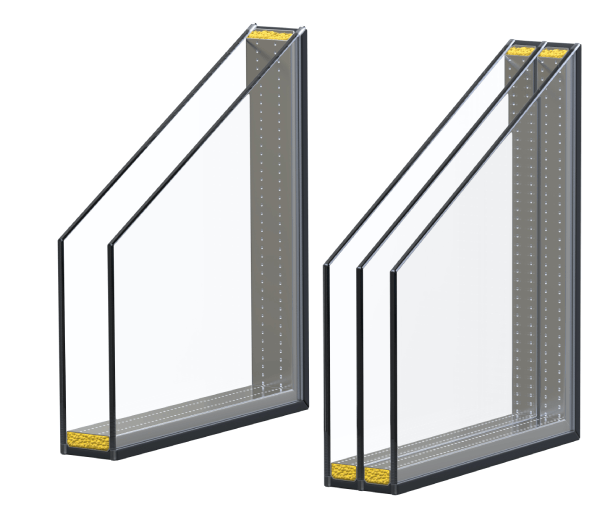
Distance frames in insulated glazing
The most common distance frame is made from aluminium, which is colder than other parts of the window. For this reason, ‘warm’ materials are also used, such as Chromatech, with such windows – being designated DGU or TGU – having become popular recently. They are a little bit more expensive than the standard frames, but they have several advantages:
– a lower level of heat transfer,
– improved condensation protection.
According to the RAL catalogue, the standard colour is 7035: grey. It is also possible to order 8016, 8003, or 9005.
Main types
Energy saving (LowE)
Energy-saving glass being used in glazing, with a special coating which makes it possible to reflect between 40-70% of heat back into the room, which is impossible when using standard glazing frames. It is possible to use two panels of such glass in triple glazing where the designation being used is LowE.
Thermal conductivity is expressed by the coefficient of thermal conductivity (W/m2K). Therefore the lower its value, the warmer is the glazing.
Comparison table:

Noise-isolating glass (SR)
Using glass of different thicknesses is permitted, as is thicker glass of 6mm or 8mm, in order to be able to reduce sound insulation. The distance between such panes should be as great as possible.
For a more significant effect, we use laminated glass with a soundproofing film, which is indicated by the use of the ‘(SR)’ marking.
Sun reflective glass (ton, Stopsol, and SN)
Sun-reflecting glass with special coatings which serve to reduce the transmission of solar energy is the standard for sun-protection double-glazed windows. These can be transparent SN70/41 or SN51/28, or tinted in bronze and grey, as well as in a mirror finish, all of which are colourless and in bronze (Stopsol).
Durable against impacts
Hardened (temps)
Hardened glass is resistant to temperature extremes and impacts. Protective properties are formed in the process of heating at high temperature, and then instant cooling. In the event of being smashed, they crumble into harmless fragments with blunt edges.
Laminated
Windows using laminated glass are interconnected by means of a special film. These are similar to standard panes, but do not fall apart when damaged as they are held together by the film. The most common combinations we recommend are:

Energy-saving, tinted, and other variants which are used in the composition of laminates.
Reinforced (arm)
Inside the reinforced glass is a wire mesh which traps any fragments if the glass happens to be shattered. Such reinforcement will greatly reduce the risk of a spread of fire and smoke.
Decorative (decor)
Frosted or patterned glass can be installed to create privacy in doors and windows.
We have a great selection which includes: Crepi, Kura, T-41, T-43, T-44, T-59, T-73, T-86, Diamante, Delta, Silvit, Chinchila, Krizet, Flutis, or Konfeta Kruopos. Before placing an order, please consult a sales representative.
Condensation
Condensation can form on the surface of the outer glass if the surface temperature of the glass is lower than the ambient air temperature. The formation of condensation on the outer surface of the glass unit determines the heat transfer coefficient of the glass unit, the relative humidity of the air, air movement at the glass surface, as well as the air temperature outside and inside.
In some cases, in glass units with good thermal insulation, condensation can form on the outer surface of the glass from the outside, when the relative outdoor humidity is high, and the outdoor temperature is higher than the temperature of the glass surface. In other words, we do not heat the street. This phenomenon is quite rare and appears more often from the northern part of the house. When the weather conditions change, this effect disappears.
If condensation is not observed in other apartments, then there is used windows with worse thermal insulation, which means that the heat of the room is lost.
Condensation on the glass surface inside a room is often caused by insufficient air movement near the glass surface, for example, curtains, blinds, deep vaults, flowerpots, unfavorably distributed heating devices or high humidity in the room, etc.
If the fogging of the window occurs inside the glass unit, this may be a defect in the glass unit and must be replaced under the Warranty during the Warranty Period.
For more information, please contact your local branch of Arutech OÜ.
